Post contributed by Valeria Aschero
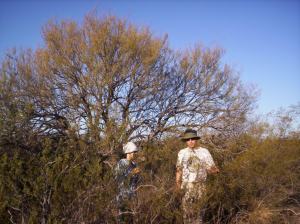
Valeria Aschero and Diego Vázquez working in Ñacuñán Biosphere Reserve. See Aschero et al. (2016) Forest Ecology & Management, Aschero et al. (2009) Austr. Ecol. and Vázquez et al. (2008) RSEA.
I have recently published a paper in Forest Ecology & Management aimed at studying how ungulates influence plant demography and population growth in different consecutive phases of their life cycle. For my PhD thesis (defended in 2011) I wanted to use a holistic approach to evaluate the demographic consequences of contrasting land use for the conservation of the desert tree Prosopis flexuosa (algarrobo dulce). One of the key things I had to learn for this project was how to use matrix population projection models, which gave me some headaches (I even had a dream in which I shared a cruise with the author of a renowned book on matrix models). This paper is the “cherry on the cake” of my PhD project, because it combines extensive observational and experimental data on the demography of P. flexuosa with matrix modeling to answer the question of how contrasting grazing regimes influence the demography and population growth of this species.
Publishing this paper would have never been possible without the cooperation of my coauthors (Bill Morris, Diego Vázquez, Juan Álvarez and Pablo Villagra), who have kindly and patiently supported me, understanding my single mother timing and my enthusiasm to get into new intellectual adventures!
You can see here the final version of the manuscript in the journal’s web site. (If you want the pdf of this paper and don’t have access to the journal, please send me an e-mail at vaschero [at] mendoza-conicet.gob.ar.)

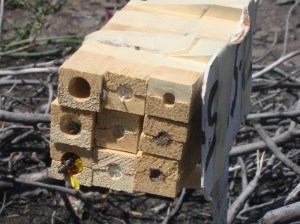
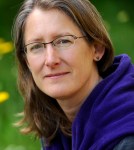
 Gretchen LeBuhn, a Professor of Biology at San Francisco State University, and Mark Reynolds, a staff scientist with The Nature Conservancy, will be in our lab spending several months of their sabbatical. Gretchen is interested in plant evolutionary ecology and pollinator conservation. Mark works on biodiviersity conservation, particularly migratory birds. Welcome Gretchen and Mark!
 A paper reviewing the ecological and evolutionary impacts of chaning climatic variability was published today in Biological Reviews. The idea for this paper started as informal chats with Ernesto Gianoli and Pancho Bozinovic during a course we taught in 2012 in Cuzco, Perú. We were all interested in changing climatic variability as one of the expected outcomes of climate change, and felt that there was a need for a synthesis on the ecological and evolutionary impacts of such changes. We later invited Bill Morris to contribute to the review, as he knows well the literature on the demographic and population-dynamic impacts of climatic variation.
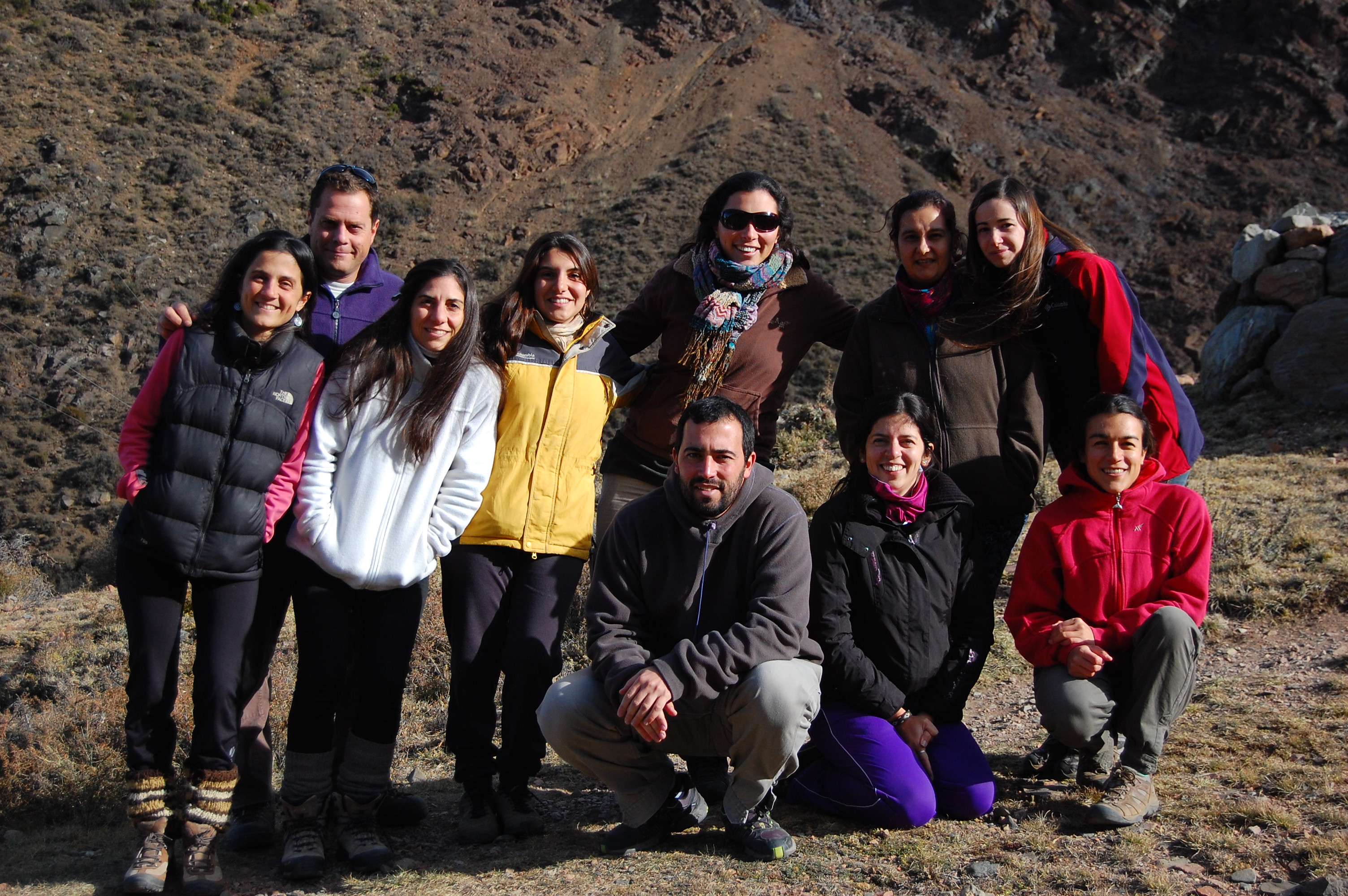
 Vero moved to start a new post-doc at the University of Río Negro, in the southern city of El Bolsón, Chubut. She’ll surely enjoy cooler temperatures there than in Mendoza. Good luck Vero!


 Ecological Interactions Lab